Ayn Rand's "The Fountainhead"
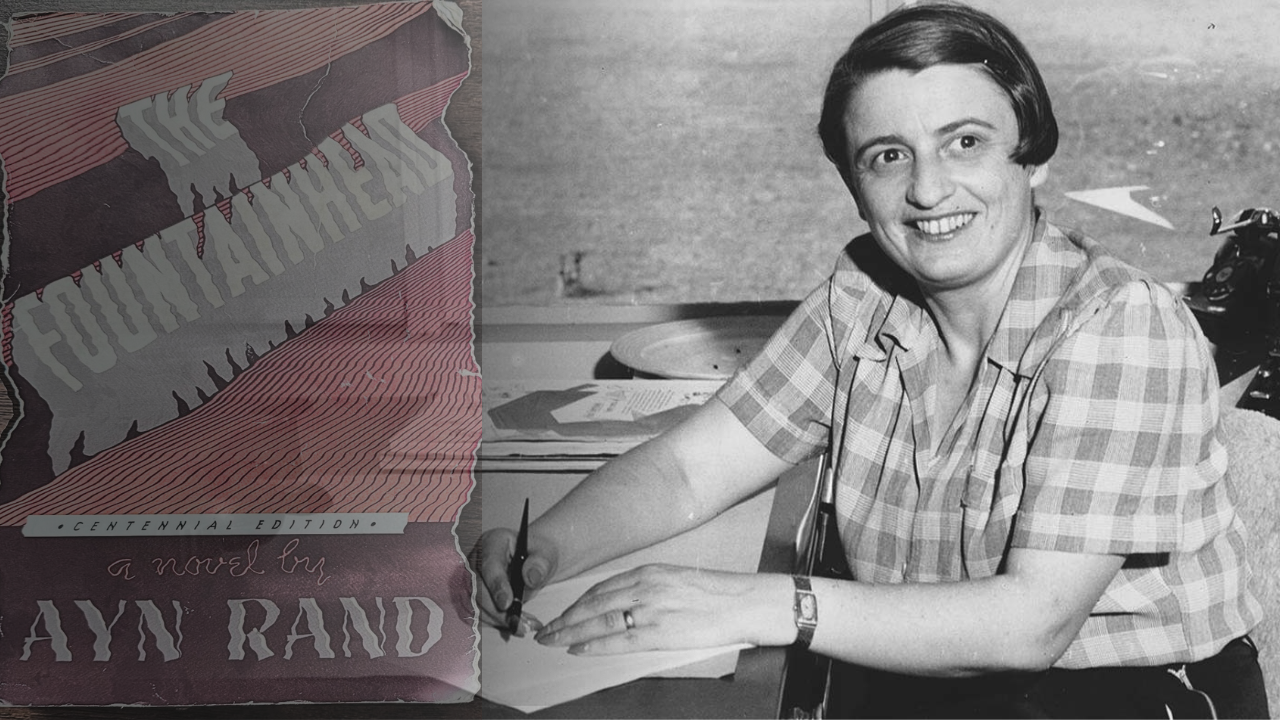
The Fountainhead - a novel by Ayn Rand is a story of an architecture named Howard Roark who expresses through his work and his life the highest that Man has the potential to achieve. Achievement not in the sense of money, possessions, fame, praise et al. - these are the things that don't hold any importance as achievements for Roark. His achievement lies in maintaining the integrity of his reason and, as a result, the authenticity of his work amidst the crowd that carries ugly rigidness in the name of integrity and mere repetitions in the name of authenticity.
From this story of struggle between what man has become and what he has the potential to be, I took out some sentences and paragraphs which hit me the hardest: [I included brackets to give some context]
"I [Roark] stand at the end of no tradition."
"I [Roark] don't intend to build in order to have clients. I intend to have clients in order to build."
"Don't you know what you want? How can you stand it not to know?"
"She was his mother; this was supposed to take the place of reason."
"His [Roark's] face was closed like the door of a safety vault; things locked in safety vaults are valuable; men did not care to feel that."
Keating is the name of a character diagonally opposite to that of Roark:
"Keating did not care so long as his clients were impressed, the clients did not care so long as their guests were impressed, the guests did not care anyway."
"Have you ever looked at them [people in general] when they are enjoying themselves? That's when you see the truth."
"There was no such person as Mrs. Wayne Wilmot; there was only a shell containing the opinions of her friends, the picture postcard she had seen, the novels of country squires she had read; it was this that he [Roark] had to address, this immateriality which could not hear him or answer, deaf and impersonal like a wad of cotton."
"It was pain, but it was blunted, unpenetrating pain. It's true, he [Roark] would tell himself; it's not, his body would answer, the strange, untouchable healthiness of his body."
"He [Keating] was certain that it [some philosophical discussion] was profound because he did not understand it."
" 'A thing is not high if one can reach it; it is not great if one can reason about it; it is not deep if one can see its bottom' - This spared him [Keating] any attempt to reach, reason or see; and it cast a nice reflection of scorn on those who made the attempt."
Another character is Dominique - a woman who knows what greatness is but doesn't believe that it can exist in a world so drunk on mediocrity.
"It was the sound of destruction and she [Dominique] liked it."
"Sometimes she [Dominique] started on foot from the house and walked for miles, setting herself no goals and no hour of return."
"Have you seen how your best friends love everything about you - except the things that count?"
"Do you know what your [Roark's] secret is? It is your terrible innocence."
"No, you can never ruin an architect by proving that he is a bad architect. But you can ruin him because he is an atheist, or because somebody sued him, or because he slept with some woman, or because he pulls wings of butterflies."
"It's so much easier to pass judgment on a man than on an idea."
"I'm [Roark] not capable of suffering completely. I never have. It goes only down to a certain point and then it stops. As long as there is that untouched point, it's not really pain."
"You [Dominique saying to Keating] are not the worst of the world. You are its best. That's what's frightening."
[A dialogue between Roark and Dominique]:
" 'Do you know Roark that the Enright House is the most beautiful building in New York?'
'I know that you know it.'
'Roark, you worked in that quarry when had Enright House in you, and many other Enright Houses, and you were drilling granite like a...' "
[Keating and other artists like him form a council]:
"It was a feeling of brotherhood, but somehow not a sainted or a noble brotherhood; yet this precisely was the comfort - that one felt, among them, no necessity for being sainted or noble."
[A dialogue between Dominique and Roark's client]:
" 'It will be a great bulding, Joel.'
'You mean, good?'
'I don't mean good, I mean great.'
'It's not the same thing?'
'No, Joel, no, it's not the same thing.'
'I don't like this'great' stuff.' "
"She [Dominique] saw faces streaming past her, the faces made alike by fear - fear as a common denominator, fear of themselves, fear of all and one another, fear making them ready to pounce upon whatever was held sacred by any single they met."
"Imbeciles always smile. Man's first frown is the first touch of God on his forehead."
"You don't run things around here. You have never run things anywhere. You have only added yourself to the things they ran."
"A face that held no pain of renunciation, but the stamp of the next step, when even the pain is renounced."
"It's the hardest thing in the world to do what we want. And it takes the greatest kind of courage. I mean, what we really want. As I wanted to marry you. Not as I want to sleep with some woman or get drunk or get my name in the papers. Those things - they are not even desires - they are the things people do to escape from desires - because it's such a big responsibility, really to want something."
"The crowd would have forgiven anything except a man who could remain normal under the vibrations of its enormous collective sneer."
"Ask anything of men. Ask them to achieve wealth, fame, love, brutality, murder, self-sacrifice. But don't ask them to achieve self-respect. They will hate your soul."
"Most people go to great lengths to convince themselves of their self-respect. And a quest for self-respect is a proof of its lack."
"One can't love man without hating most of the creatures who pretend to bear his name."
"Love is reverence, worship, and glory, and the upward glance. Not a bandage for dirty sores. But they don't know it. Those who speak of love most promiscuously are the ones who have never felt it. They make some sort of stew out of sympathy, compassion, contempt, and general indifference, and they call it love."
"Once you have felt what it means to love as you and I know it - the total passion for the total height - you are incapable of anything else."
"When I stop at a port, it's only for the sheer pleasure of leaving it. I always think: here's one more spot that can't hold me."
"I often think he [Roark] is the only one of us who has achieved immortality. I don't mean it in the sense of fame, and I don't mean that he won't die some day. But he is living it. I think he is what the conception really means. You know how people long to be eternal. But they die with every day that passes. When you meet them, they are not what you met last. In any given hour, they kill some part of themselves. They change, they deny, they contradict - and they call it growth. At the end there's nothing left, nothing unreversed or unbetrayed; as if there had never been any entity, only a succession of adjectives fading in and out of an unformed mass. How do they expect a permanence which they have never held for a single moment? But Howard - one can imagine him existing forever."
"It was inactivity he [Keating] dreaded; it was the question mark looming beyond, if the routine of his work were to be taken away from him."
"How much is unimportant and how easy it is to live."
"The hardest thing to explain is the glaringly evident which everybody has decided not to see."
"There is a stage of worship where the worshiper itself is an object of reverence."
"The worst thing about dishonest people is what they think of as honesty."